What does Ohio homeowners insurance cost in 2024?
If you own a home in Ohio, you have probably wondered whether you are paying too much, too little, or about the right amount for homeowners insurance. The honest answer is that it depends on a long list of factors unique to your property, your location, and the coverage you choose. The statewide average for Ohio homeowners insurance runs roughly $1,100 to $1,400 per year for a policy with $250,000 in dwelling coverage, which is noticeably lower than the national average. Averages only tell part of the story, though. A home in the Hocking Hills area can carry a very different premium than one along the Ohio River near Proctorville or South Point, and knowing why helps you shop smarter.
Key factors that drive your Ohio homeowners insurance cost
Insurance companies use a combination of property data, local risk indicators, and your personal history to calculate your rate. The following factors carry the most weight.
Dwelling replacement cost
Your policy's dwelling coverage limit should reflect what it would cost to rebuild your home from the ground up, not what you paid for it or what it would sell for today. Construction costs in Ohio have climbed significantly since 2020, so older policies may be underinsured. A home with a $300,000 replacement cost will cost more to insure than one valued at $175,000, all else being equal. Insurers use per-square-foot rebuild estimates tied to local labor and material prices when setting this number.
Location and local hazard exposure
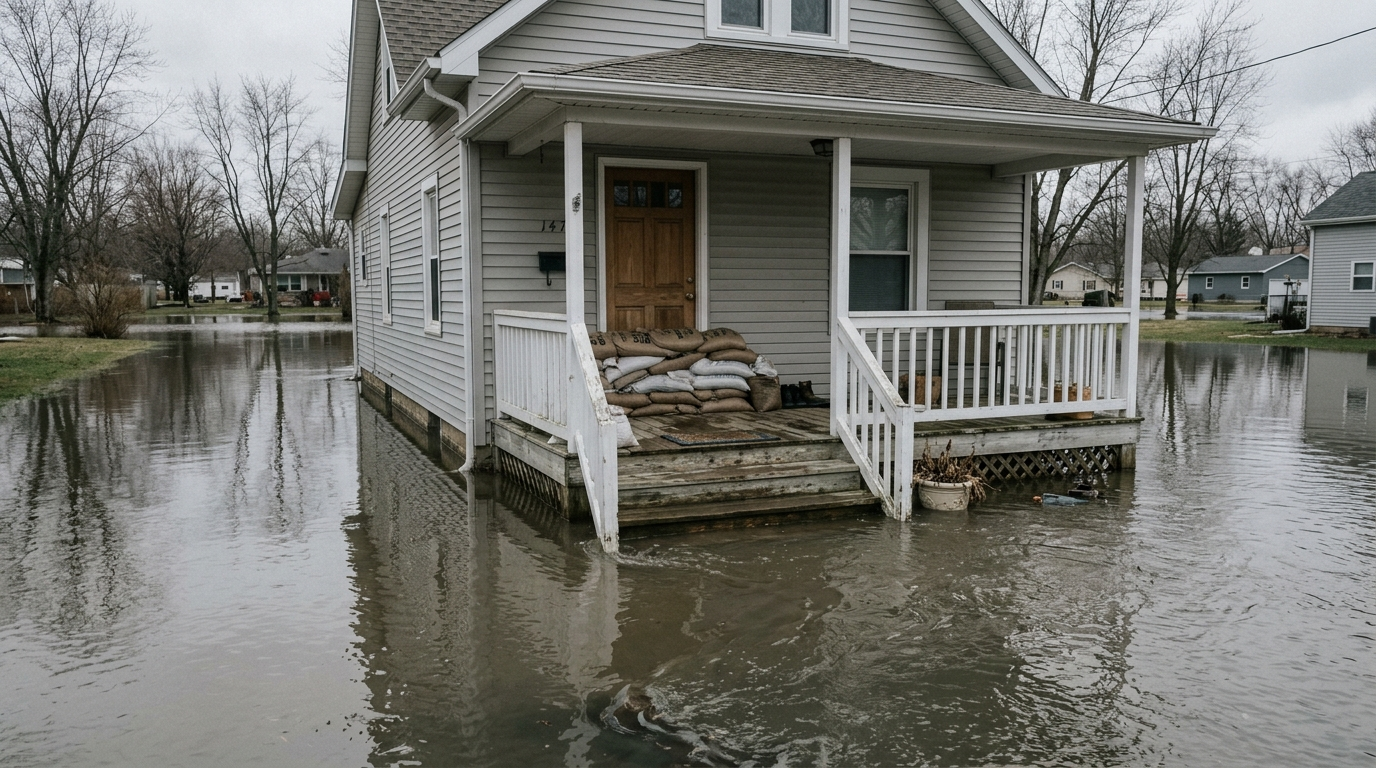
Where your home sits in Ohio matters a great deal. Southern Ohio counties along the river corridor, including Lawrence and Gallia counties, face periodic flooding. Central Ohio sees the state's highest frequency of severe thunderstorms and hail events. Northeast Ohio contends with heavy lake-effect snow and ice damage. Insurers price these regional risks into your base rate. If you live in a high-flood zone, your standard homeowners policy will not cover rising water. You would need a separate personal flood policy to close that gap.
Age and condition of the home
Older homes cost more to insure. A house built before 1970 often has original plumbing, knob-and-tube wiring, or aging roof materials that make claims more likely and more expensive. Some carriers will decline coverage outright on homes with certain outdated systems, while others will insure them at a higher rate. Updating the roof, electrical panel, or HVAC system can meaningfully reduce your premium and open up more carrier options.
Roof age and material
In Ohio, where hail and high winds are common spring and summer events, your roof is the single biggest driver of claim frequency. Carriers pay close attention to roof age and material type. An asphalt shingle roof that is 15 or more years old may be insured only on an actual cash value (ACV) basis, meaning depreciation is deducted from any claim payout rather than paying the full replacement cost. A newer roof, especially one with impact-resistant shingles, can earn you a discount on your premium.
Claims history
Your personal claims history and the claims history associated with the property address both influence pricing. Carriers access a national database called CLUE (Comprehensive Loss Underwriting Exchange) to see prior claims, including ones filed by a previous owner. Multiple claims in a five-year window, especially water or liability claims, signal elevated risk and push rates up. This does not mean you should avoid filing legitimate claims. It does mean that frequency matters to underwriters.
Credit score
Ohio allows insurers to use credit-based insurance scores as a rating factor, and the impact can be significant. Research consistently shows a correlation between credit history and claim frequency. Homeowners with excellent credit can pay 20 to 40 percent less than those with poor credit for otherwise identical coverage. If your credit has improved recently, it is worth asking your agent to re-run the numbers.
Coverage limits and deductibles
Your deductible is the amount you pay out of pocket before your policy pays. Choosing a $2,500 deductible instead of a $1,000 deductible can lower your annual premium by $150 to $300 or more, depending on your carrier. Just make sure you could comfortably cover that higher deductible if a storm hits next week. Some Ohio policies now include a separate wind or hail deductible expressed as a percentage of the dwelling value (often 1% or 2%) rather than a flat dollar amount, so read that section of your policy carefully.
What a standard Ohio homeowners policy actually covers
A standard HO-3 policy, the most common form, provides open-peril coverage on the dwelling structure and named-peril coverage on personal property. The house itself is covered for any cause of loss not specifically excluded, while your belongings are covered only for the causes listed in the policy.
- Dwelling (Coverage A) : pays to repair or rebuild the structure of your home after a covered loss like fire, wind, or hail.
- Other structures (Coverage B) : covers detached garages, fences, and outbuildings, typically at 10% of your dwelling limit.
- Personal property (Coverage C) : replaces furniture, clothing, electronics, and other belongings lost to a covered peril.
- Loss of use (Coverage D) : pays hotel and meal expenses if your home is uninhabitable after a covered claim.
- Personal liability (Coverage E) : protects you if someone is injured on your property and sues you. Standard limits start at $100,000, but $300,000 is more realistic for most homeowners.
- Medical payments (Coverage F) : covers minor medical bills for guests injured on your property, regardless of fault.
For a closer look at what each of these coverages pays for and what it does not, our post on what your home insurance policy really covers walks through the details in plain language.
Common coverage gaps Ohio homeowners should know about
Even a solid HO-3 policy has exclusions that catch people off guard after a loss. Here are the ones we see most often.
Flood damage
Standard homeowners policies exclude damage caused by flooding, surface water, or overflowing bodies of water. For homeowners along the Ohio River in Lawrence County, or those in low-lying areas near streams and creeks, this gap is serious. Flood insurance is available through the National Flood Insurance Program (NFIP) and through a growing number of private carriers. Rates vary based on your elevation certificate and flood zone designation. Do not assume you are safe because you have never flooded before. Flood maps change, and a single event can cause catastrophic damage with no prior history.
Sewer and water backup
Water backing up through a drain or sump pump overflow is excluded from most base policies but can be added as an endorsement, typically for $50 to $150 per year . Given Ohio's aging infrastructure in older communities, this is one of the most cost-effective add-ons available.
High-value personal property
Standard personal property coverage caps payouts on certain categories. Jewelry, for example, is often limited to $1,500 for theft regardless of actual value. If you have an engagement ring, heirloom pieces, or a coin collection worth more, a scheduled personal property endorsement provides itemized coverage at appraised value with no deductible in many cases. The Hutch Agency also offers a standalone jewelry insurance option worth exploring.
Earthquake
Ohio is not California, but the state does experience minor seismic activity, particularly in the eastern and southeastern portions near old mining areas. Earthquake coverage is excluded from standard policies but can be added separately through earthquake insurance. Premiums are generally low in Ohio because the risk is relatively modest, making it an affordable add-on.
How to lower your Ohio homeowners insurance cost
No single change will drop your rate dramatically, but combining several strategies can produce meaningful savings.
- Bundle home and auto : Most carriers offer a discount of 10 to 20 percent when you place both policies with the same company. Our post on bundling home and auto breaks down exactly how much you can realistically save.
- Raise your deductible : Moving from a $500 to a $1,500 or $2,500 deductible reduces your premium immediately. Reserve small claims for when you really need the coverage.
- Install protective devices : Monitored alarm systems, smoke detectors, deadbolts, and water leak sensors all generate discounts with most carriers.
- Improve your roof : A roof under 10 years old, especially with Class 4 impact-resistant shingles, earns significant premium credits with many Ohio carriers.
- Maintain good credit : Paying bills on time and keeping credit utilization low pays off in more places than just loan rates.
- Shop the market regularly : Carrier pricing changes every year, and loyalty does not always earn you the best deal. Comparing rates from multiple companies is the most reliable way to find savings.
Ohio-specific considerations worth knowing
Ohio does not require homeowners insurance by law, but your mortgage lender almost certainly does. If you drop coverage or let it lapse, the lender can place force-placed insurance on your home, which typically costs two to three times what a standard policy costs and covers only the lender's interest, not your belongings or liability.
Ohio also has no state-run insurer of last resort the way some coastal states do. If your home is declined by standard carriers due to age, condition, or claims history, coverage is still available through the surplus lines market, often called the non-admitted market. Premiums are higher, but it is a legitimate solution while you work to improve the property's insurability. An independent agent who works with multiple markets is your best resource in that situation.
On hail claims specifically: Ohio ranked in the top ten states for hail damage claims in recent years, and if you have experienced a significant storm, knowing how to document and file that claim properly is worth the effort. Our post on Ohio hail damage home insurance claims covers the process step by step.
Get a personalized rate from The Hutch Agency
Understanding the factors behind Ohio homeowners insurance cost is useful, but the only number that really matters is yours. Rates vary enough between carriers that two identical homes in the same zip code can have premiums that differ by hundreds of dollars per year. The Hutch Agency is an independent insurance agency, which means we work with multiple carriers and compare options on your behalf rather than pushing a single company's products. We serve homeowners throughout southern Ohio and the surrounding region, and we know the local market, the local risks, and which carriers consistently perform well when claims need to be paid.
Call us at (740) 886-7200 or visit our contact page to get a homeowners insurance quote. There is no obligation, and the comparison takes far less time than you might expect.